
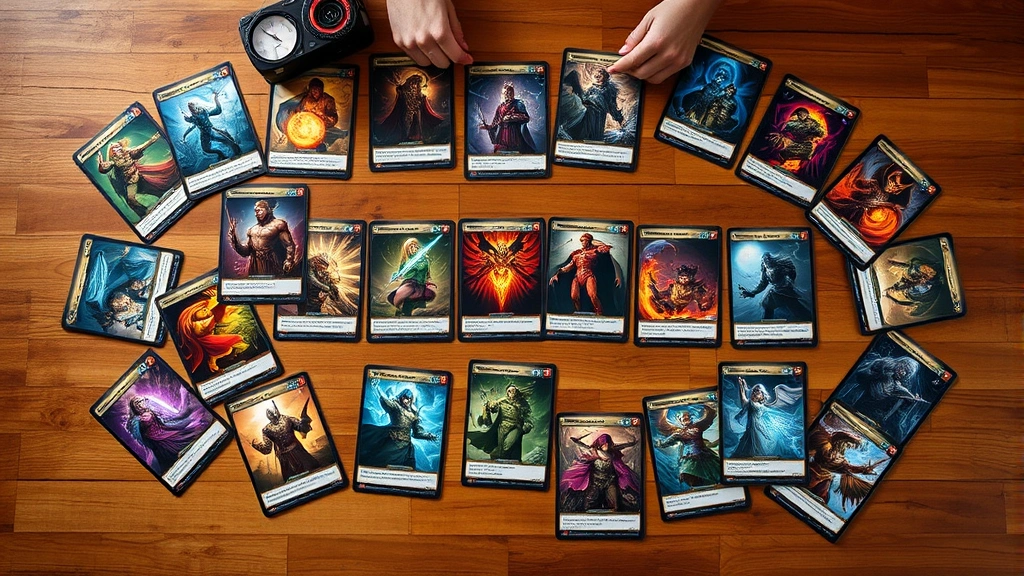
Mistborn Deckbuilding Tips: Expert Strategies to Dominate the Game
The Mistborn deckbuilding game has captivated strategy enthusiasts with its intricate card mechanics and thematic depth inspired by Brandon Sanderson’s beloved fantasy universe. Whether you’re a seasoned deckbuilder or stepping into the world of Mistborn for the first time, mastering the fundamentals of deck construction is essential to achieving victory. This comprehensive guide will walk you through expert strategies that transform casual players into competitive deckbuilding masters.
Deckbuilding in Mistborn requires more than just throwing powerful cards together—it demands understanding synergies, resource management, and the delicate balance between offense and defense. The game’s unique mechanics reward players who think several turns ahead and adapt their strategies based on their opponent’s deck composition. By implementing the strategies outlined in this guide, you’ll develop the skills needed to construct decks that consistently outperform the competition.

Understanding Mistborn Card Types and Mechanics
Before constructing your first competitive deck, you must understand the foundational card types that form the backbone of Mistborn deckbuilding. The game features several distinct card categories, each serving specific strategic purposes. Allomancer cards represent your primary power source, enabling you to cast spells and abilities that directly impact the game state. Artifact cards provide persistent effects that accumulate value over multiple turns, making them crucial for long-term strategy.
Action cards create immediate effects that can shift momentum in critical moments, while Creature cards establish your board presence and serve as both offensive threats and defensive walls. Understanding when to deploy each card type is fundamental to successful deckbuilding. The Mistborn universe’s magic system, based on Brandon Sanderson’s Allomancy, directly influences how cards interact with one another.
The game also incorporates Resource tokens that serve as currency for casting spells and activating abilities. These tokens regenerate on a predictable schedule, making resource management a core strategic element. Players who master resource prediction can unleash devastating combinations while keeping their opponent’s options limited. Additionally, Loyalty cards represent character allegiances that unlock special abilities and bonuses when conditions are met.
Studying the official Craftsmanship Games Mistborn card database provides comprehensive information about every card’s mechanics and interactions. This resource is invaluable for deckbuilders seeking to understand obscure synergies and hidden interactions that separate amateur players from masters.

Core Deckbuilding Principles
Successful deckbuilding begins with establishing a clear strategic identity for your deck. Rather than assembling a collection of powerful cards, elite players construct decks around cohesive themes and win conditions. Your deck should answer three fundamental questions: How do I win?, How do I survive until my win condition activates?, and How do I disrupt my opponent’s strategy?
The principle of deck consistency cannot be overstated. A deck that reliably executes its game plan defeats a deck with marginally more powerful cards that fail to assemble their pieces. This means including sufficient tutors—cards that search your deck for specific cards—and redundancy in your key components. If your strategy relies on a specific card, including multiple similar cards ensures you draw the effect you need when you need it.
Consider the best indie games for PC that emphasize strategic depth—Mistborn shares this commitment to rewarding careful planning and adaptation. Building your deck with consistency as a priority ensures you’re not relying on lucky draws to execute your strategy.
Deck size optimization is another critical principle often overlooked by beginners. While larger decks provide more options, they simultaneously reduce the probability of drawing your key cards. The optimal deck size balances flexibility with consistency. Most competitive Mistborn decks fall within the 50-65 card range, though some aggressive strategies benefit from even tighter constraints.
Your deck should include a balance of proactive and reactive cards. Proactive cards advance your game plan and force your opponent to respond, while reactive cards answer threats and disrupt your opponent’s strategy. The optimal ratio depends on your deck’s archetype, but generally, 60-70% proactive and 30-40% reactive provides a solid foundation.
Mana Curve and Resource Management
The mana curve—the distribution of card costs across your deck—directly influences your ability to execute your strategy consistently. A well-constructed mana curve ensures you have meaningful plays available every turn, preventing the frustrating scenarios where you’re flooded with expensive cards or stuck with weak early options.
Begin by mapping out your curve visually. Create a graph with card costs on the x-axis and quantity on the y-axis. Your ideal curve typically resembles a smooth hill, with most cards clustered in the mid-range (3-5 cost) and gradually declining toward higher costs. This distribution ensures you’re never stuck waiting for resources to accumulate.
Early game cards (1-2 cost) establish your presence and develop your board position. Include enough early plays to maintain tempo and prevent your opponent from gaining an insurmountable advantage. Mid-game cards (3-5 cost) represent your deck’s power core, containing your most impactful effects and synergistic pieces. Late-game cards (6+ cost) should represent your ultimate threats and game-ending effects.
Understanding resource generation is equally crucial. Some cards generate additional resources when cast, effectively reducing their actual cost. These cards are exceptionally valuable because they accelerate your strategy while maintaining tempo. Conversely, cards that consume resources without generating value should be evaluated carefully unless they provide exceptional effects.
The concept of resource smoothing involves including cards that convert one resource type into another. In Mistborn, this might mean cards that convert excess resources into card draw or damage. These conversion cards provide flexibility and ensure your resources aren’t wasted on unused capacity.
Synergy and Combo Building
The most exciting aspect of deckbuilding involves discovering and exploiting synergies between cards. Synergy occurs when two or more cards create effects greater than the sum of their parts. Master deckbuilders intentionally construct decks around powerful synergies, creating coherent strategies that feel inevitable once assembled.
Identify your deck’s synergy anchors—powerful cards that enable multiple other cards in your deck. For example, a card that generates resource tokens becomes exponentially more valuable if your deck contains numerous cards that benefit from resource abundance. By building around these anchors, you create decks where most cards provide multiple benefits.
Combo chains represent sequences of cards that produce spectacular results. A simple combo might involve playing a card that generates resources, then immediately playing a high-impact card that consumes those resources. More complex combos might involve five or more cards working in concert. The key to combo deckbuilding is ensuring your combos remain accessible—if you need perfect draws to execute your strategy, you’ll lose consistently.
When building combo decks, include tutors and consistency pieces that search for combo components. The probability of assembling your combo dramatically increases when you can actively search for missing pieces rather than relying entirely on random draws. Additionally, include backup plans and alternative synergies so your deck doesn’t collapse if key pieces are removed.
Examine how the best co-op games on Steam balance complexity with accessibility—Mistborn deckbuilding should follow similar principles. Your synergies should feel powerful without requiring impossibly perfect draws to function.
Meta Analysis and Adaptation
Successful deckbuilding requires understanding the competitive environment, known as the meta. The meta represents the current distribution of popular decks and strategies in competitive play. By analyzing the meta, you can construct decks specifically designed to counter popular strategies while remaining resilient against unexpected matchups.
Begin by studying IGN’s coverage of competitive card games for insights into how professionals approach deckbuilding and meta analysis. Understanding professional strategies accelerates your development as a deckbuilder.
Meta-game positioning involves choosing a strategic niche that exploits weaknesses in popular decks. If the meta consists primarily of aggressive decks, including defensive tools and life gain becomes invaluable. Conversely, if control decks dominate, aggressive strategies and cards that bypass defensive effects gain value. This dynamic interplay between decks creates an ever-evolving competitive landscape.
Track the win rates of various archetypes and identify which strategies consistently perform well. This data reveals which cards and synergies are genuinely powerful versus which appear powerful but underperform in practice. Many aspiring deckbuilders fall in love with cards or strategies that seem powerful in theory but fail against refined competitive decks.
Include sideboard cards specifically designed to address problematic matchups. Your main deck should be optimized for your expected meta, while your sideboard contains specialized tools for matchups where your main deck struggles. This approach allows you to maintain a cohesive main deck while gaining flexibility in sideboarded games.
Common Mistakes to Avoid
Overvaluing individual card power represents the most common deckbuilding mistake. New players often include the highest-power cards available, creating unfocused decks that lack coherent strategies. A deck of individually powerful cards frequently underperforms against decks with weaker cards that work together synergistically. Resist the temptation to include every powerful card and instead focus on cards that advance your core strategy.
Ignoring mana base optimization causes consistent performance problems. Many players treat mana requirements as afterthoughts, then wonder why they frequently can’t cast the cards in their hand. Carefully evaluate your mana requirements and ensure your deck can reliably produce the resources needed for your game plan.
Failing to adapt to changing metagames leads to stagnant strategies that gradually become obsolete. Successful deckbuilders continuously refine their decks based on tournament results and emerging strategies. Attend tournaments, study decklists, and be willing to make significant changes when evidence suggests your current approach is suboptimal.
Inadequate playtesting means you’re flying blind regarding your deck’s actual performance. Test your deck extensively against diverse matchups before committing to competitive play. Playtesting reveals weaknesses you couldn’t identify through theory alone and helps you understand how your deck performs under pressure.
Including too many one-ofs destroys consistency. Unless a card is completely unique or situational, including multiple copies dramatically increases the probability of drawing the effects you need. The only exception involves cards with severe drawbacks or legendary restrictions that limit the number you can include.
Explore Game Forge Daily Blog for additional deckbuilding insights and strategy discussions from experienced players. The community’s collective knowledge accelerates your development as a deckbuilder.
Overestimating card draw value leads players to include excessive draw effects at the expense of other strategies. While card draw is valuable, it only matters if you’re drawing cards that advance your game plan. A deck that draws cards but lacks a coherent strategy will still lose to focused decks with better plans.
Finally, neglecting your win conditions results in games where you’ve stabilized and controlled the board but lack a path to victory. Always include sufficient win conditions and ensure they’re achievable within a reasonable timeframe. A deck that takes thirty turns to win is vulnerable to decks that win in fifteen.
FAQ
What’s the ideal deck size for Mistborn deckbuilding?
Most competitive Mistborn decks range from 50-65 cards. Smaller decks increase consistency, while larger decks provide more options. Your optimal size depends on your strategy and card synergies. Aggressive decks typically benefit from smaller sizes, while control decks with diverse answers can accommodate larger sizes.
How many copies of each card should I include?
Include multiple copies of cards that form your core strategy. Generally, include three copies of essential cards, two copies of important supporting cards, and one copy of situational or unique cards. Exceptions exist for cards with legendary restrictions or those requiring specific conditions to function.
Should my deck focus on offense or defense?
The optimal balance depends on your archetype and meta. Aggressive decks prioritize offense with minimal defensive tools, while control decks emphasize answers and removal. Most competitive decks include both elements, with the ratio adjusted based on strategic identity. Test your deck to determine the optimal balance.
How do I know if my synergies are too ambitious?
If your strategy requires more than three or four specific cards to function, it’s likely too ambitious. Your core synergies should activate when you’ve assembled two or three key pieces. Additional cards should enhance your strategy rather than being essential for basic functionality.
What’s the most important aspect of deckbuilding?
Consistency is paramount. A deck that reliably executes its game plan defeats a deck with marginally more powerful cards that fail to assemble. Include sufficient tutors, redundancy, and card draw to ensure you’re drawing the pieces you need when you need them.
How frequently should I update my deck?
Update your deck whenever tournament results or meta shifts suggest changes would improve your win rate. Minor adjustments (swapping one card for another) can happen frequently, while major overhauls should occur when your current strategy consistently underperforms against popular decks. However, avoid constant changes that prevent you from mastering your deck’s nuances.
Where can I find competitive decklists to study?
Check GameSpot’s coverage of competitive card games for tournament results and professional decklists. Additionally, community websites and tournament organizers publish winning decklists that provide insights into successful strategies and card choices.
Should I include cards I haven’t tested?
Never include untested cards in competitive decks. Playtest extensively before committing to new inclusions. Even cards that seem powerful in theory often underperform or disrupt your deck’s synergies. Thorough testing prevents costly mistakes in important tournaments.