

Master the Hook and Ring Game! Expert Tips Inside
The hook and ring game has captivated players for generations, blending simple mechanics with surprisingly deep strategy and skill. Whether you’re discovering this classic game for the first time or looking to elevate your performance, this comprehensive guide will transform you into a true master. This timeless carnival favorite and casual gaming staple demands precision, patience, and practice—but the rewards of success are incredibly satisfying.
In recent years, the hook and ring game has experienced a resurgence in popularity, appearing in arcade collections, mobile applications, and even dedicated gaming experiences. Understanding the nuances of this deceptively challenging game can mean the difference between frustrating misses and impressive victories. From beginner fundamentals to advanced techniques employed by competitive players, we’ll explore everything you need to dominate this engaging pastime.
Understanding the Basics of Hook and Ring
The hook and ring game is fundamentally about precision and control. The objective is straightforward: swing a ring suspended by a string toward a hook, attempting to land the ring onto the hook successfully. While this sounds simple, the execution requires remarkable hand-eye coordination and understanding of physics principles like momentum, trajectory, and pendulum motion.
The game’s appeal lies in its accessibility combined with its skill ceiling. Beginners can enjoy casual play and occasional successes, while dedicated players can refine their technique to achieve consistent results. The beauty of mastering this game is that it translates to improved performance in other cooperative gaming experiences requiring precision and teamwork.
Understanding the game’s mechanics is your first step toward improvement. The ring must follow a specific trajectory, accounting for the string’s length, the hook’s position, and the force applied during the swing. Professional players develop an intuitive sense for these variables, but beginners must consciously study and practice each element.
Perfecting Your Grip and Stance
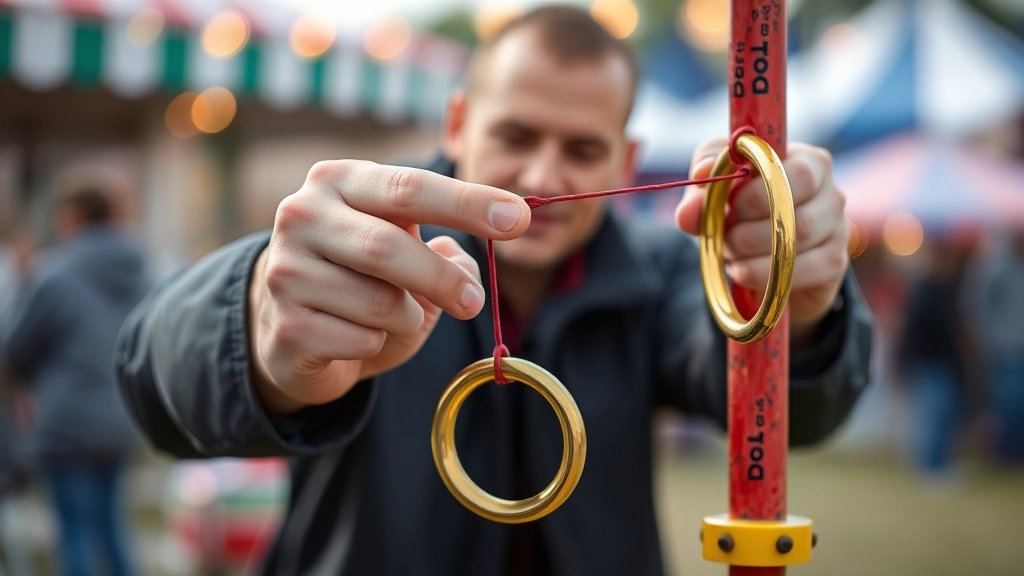
Your foundation for success begins with establishing the correct grip and stance. The way you hold the ring’s string directly impacts your control and consistency. Most successful players recommend gripping the string with your dominant hand, positioning your fingers approximately one-third of the way down from the top. This grip point provides optimal leverage while maintaining control throughout the swing.
Your stance should be comfortable yet stable. Position your feet shoulder-width apart, with your non-dominant shoulder pointing slightly toward the hook. This positioning allows for natural arm movement and proper weight distribution. Keep your knees slightly bent to absorb momentum and maintain balance throughout the swing cycle.
The angle of your initial hold matters significantly. Begin with the ring hanging naturally at approximately 45 degrees from vertical. This starting position enables smooth acceleration and helps establish the proper pendulum motion. Many beginners hold the ring too vertically or at awkward angles, immediately handicapping their performance before the swing even begins.
Your arm movement should originate from the shoulder, not the wrist. The entire motion should feel fluid and controlled, like a professional athlete executing a well-practiced skill. Avoid jerky movements or excessive force—consistency and smoothness trump raw power in this game.
Mastering Timing and Rhythm
Timing is absolutely critical in the hook and ring game. The ring must approach the hook at precisely the right moment in its swing arc. Release timing determines whether the ring lands cleanly on the hook, bounces off, or misses entirely. Elite players develop an almost musical sense of rhythm, timing their release like a drummer hitting the beat perfectly.
The pendulum principle governs the ring’s motion. Once you initiate the swing, the ring follows a predictable path. Understanding this path allows you to anticipate exactly when the ring will reach the hook. Begin by practicing slow, controlled swings to internalize the timing without rushing. Speed comes naturally once timing becomes second nature.
Many players benefit from counting or using internal rhythm cues. Some professionals mentally count “one, two, three” corresponding to the swing phases, releasing on the optimal count. Others visualize the ring’s path and release based on position rather than time. Experiment with different mental frameworks to discover what works best for your brain and muscle memory.
Wind and environmental factors can affect timing in outdoor settings. When playing traditional carnival versions or outdoor games, account for air currents that might alter the ring’s trajectory. Indoor versions eliminate this variable, allowing you to focus purely on mechanical technique and timing.
Advanced Techniques for Competitive Play
Once you’ve mastered the fundamentals, advanced techniques separate casual players from competitors. The hook and ring game at competitive levels involves subtle variations in grip pressure, swing amplitude, and release angle that dramatically affect success rates.
The “controlled acceleration” technique involves gradually increasing force throughout the swing rather than applying maximum force immediately. This method provides better control and allows for micro-adjustments mid-swing. Professional players often use this technique to adapt to slight variations in conditions or equipment.
The “angle variation” strategy involves intentionally approaching the hook from slightly different angles on successive attempts. This prevents your muscles from developing a single rigid pattern and keeps your technique adaptable. Versatility is crucial because real-world conditions rarely remain perfectly constant.
Advanced players also master the “soft landing” technique. Rather than trying to drive the ring forcefully onto the hook, they focus on delivering it gently with just enough momentum for secure placement. This technique reduces bounce-offs and increases success rates significantly.
Consider exploring competitive gaming communities and indie gaming platforms that feature digital versions of the hook and ring game. These platforms often attract serious competitors who share strategies and techniques, accelerating your learning curve dramatically.
Common Mistakes and How to Avoid Them
Understanding what not to do is equally important as knowing what to do. The most common mistake is applying excessive force. Beginners often believe more power equals better results, when actually, controlled precision outperforms brute force every single time.
Another prevalent error is inconsistent starting position. If you begin each attempt with slightly different grip positions or ring angles, you’ll never develop reliable muscle memory. Establish a consistent starting ritual and execute it identically every single time.
Many players fail to account for the hook’s exact position. Spend time studying your specific hook—its height, angle, and distance from your starting position. Different hooks require slightly different techniques. What works perfectly on one hook might need adjustment for another.
Rushing your practice is a critical mistake. Attempting hundreds of quick swings without focused concentration teaches your muscles bad habits. Instead, practice deliberately with complete focus on each individual attempt. Quality vastly outweighs quantity in skill development.
Neglecting your mental state is another common pitfall. Frustration, overconfidence, and anxiety all degrade performance. Develop mental resilience and maintain emotional equilibrium throughout your practice sessions and competitive play.
Avoid changing your technique constantly. While adaptation is important, excessive modification prevents you from developing mastery. Make intentional, deliberate changes based on analysis, not reactionary adjustments after single failures.

The Mental Game: Psychology and Focus
The psychological dimension of the hook and ring game is often underestimated. Your mental state directly impacts your physical performance. Champions in any competitive field understand that the mind controls the body, not the reverse.
Developing focus is paramount. When attempting the hook and ring game, eliminate distractions completely. Silence your phone, find a quiet location, and create an environment where you can concentrate intensely. Professional athletes spend significant time developing concentration skills because they understand its importance.
Visualization is a powerful technique used by successful players. Before attempting the swing, visualize the perfect execution in your mind. See the ring’s path, feel the motion, and imagine the successful landing. This mental rehearsal activates the same neural pathways as physical practice, strengthening your skills.
Managing pressure and anxiety is crucial during competitive situations. Develop breathing techniques to calm your nervous system before high-stakes attempts. Many professionals use slow, deep breathing—inhaling for four counts, holding for four counts, exhaling for four counts—to establish mental equilibrium.
Building confidence through successful practice sessions creates a positive feedback loop. Each successful attempt reinforces your belief in your abilities, which subsequently improves your actual performance. This positive psychology cycle is incredibly powerful.
Learning from failures without becoming discouraged is essential. Each miss provides valuable information about what needs adjustment. Reframe failures as learning opportunities rather than defeats. This growth mindset accelerates improvement significantly.
Effective Practice Routines
Structured practice is infinitely more valuable than random, unfocused attempts. Design a practice routine that systematically develops different aspects of your skill. A comprehensive routine might include warm-up swings, focused technique work, pressure simulation, and cool-down analysis.
Begin each session with ten to fifteen minutes of relaxed warm-up swings. These shouldn’t be competitive attempts—instead, focus on smooth motion and getting comfortable with the equipment. Gradually increase your focus intensity as you warm up.
Dedicate the main portion of your practice to specific technique development. Work on one particular aspect per session. For example, Monday might focus on grip consistency, Tuesday on timing precision, Wednesday on angle variation. This targeted approach accelerates skill development.
Incorporate pressure simulation into your routine. After technical work, practice under simulated competitive conditions. Set performance goals and track success rates. This trains your mind and body to perform when it matters most.
Keep detailed records of your practice sessions. Document what worked, what didn’t, and what you discovered. This data helps you identify patterns and optimize your training approach. Many elite players maintain practice journals for exactly this reason.
Vary your practice environment occasionally. While consistency is important, practicing in different locations with different equipment helps develop adaptability. You might visit an arcade, try different hooks, or practice with equipment variations to build versatility.
Dedicate time to studying other skilled players. Watch videos of competitive play, attend tournaments, or observe experienced players in action. Learning from others’ techniques and strategies accelerates your development considerably. This mirrors how players improve in gaming setups by studying professional configurations.
Choosing the Right Equipment
Equipment quality significantly impacts your performance in the hook and ring game. While the game’s simplicity might suggest equipment doesn’t matter much, serious players know that subtle equipment variations create noticeable performance differences.
The string’s material and thickness affect how the ring swings and responds to your input. Most competitive players prefer strings made from durable synthetic materials that maintain consistent properties over extended use. Natural fiber strings can absorb moisture and change their characteristics, introducing unwanted variables.
The ring itself requires careful consideration. Weight distribution, material, and size all influence performance. Heavier rings behave differently than lighter ones, requiring technique adjustments. Most players develop preferences through experimentation, then stick with equipment that suits their style.
The hook’s design matters tremendously. Different hooks have varying angles, thicknesses, and surfaces. A hook with sharper edges might grab the ring more reliably, while a smoother hook requires different technique. Understanding your specific hook’s characteristics is essential for optimization.
Invest in quality equipment rather than the cheapest option available. Premium equipment maintains consistent properties, reducing variables and allowing you to focus on technique refinement. This principle applies to gaming setups as well—quality equipment enhances performance across all competitive activities.
Consider the environmental conditions your equipment will face. If you play outdoors, choose materials that resist weather damage. If you play indoors, different considerations apply. Equipment durability and maintenance become important factors in long-term skill development.
For digital versions of the game, explore different mobile games and offline options to find versions that match your preferred playstyle. Different digital implementations offer varying physics engines and difficulty settings.
FAQ
What’s the ideal grip pressure for the hook and ring game?
Grip pressure should be firm enough to maintain control but not so tight that tension transfers to your arm and hand. A common analogy is holding a bird—firm enough that it won’t escape, but gentle enough that you won’t harm it. Most players find that a moderately firm grip allows optimal control and consistency.
How long does it typically take to become proficient?
With dedicated practice, most people achieve competent performance within two to four weeks of consistent training. However, reaching elite competitive levels typically requires several months of focused practice. The learning curve accelerates significantly once you’ve internalized the fundamentals.
Can I improve without physical practice?
While mental visualization and studying others’ techniques provide benefits, physical practice is irreplaceable. Your muscles must develop the specific motor patterns required for success. Mental training complements physical practice but cannot substitute for it entirely.
What’s the difference between indoor and outdoor play?
Indoor play eliminates wind variables, allowing you to focus purely on technique. Outdoor play introduces environmental challenges that require adaptability. Many players find indoor play more consistent, while outdoor play develops overall skill versatility.
Should I practice with different hooks?
Practicing with various hooks develops adaptability and prevents over-specialization. However, when preparing for specific competitions, practice primarily with the exact hook you’ll face. Balance general skill development with situation-specific preparation.
How do I overcome performance anxiety?
Develop a pre-attempt routine that includes breathing exercises and positive self-talk. Practice extensively under pressure-simulated conditions so competitive situations feel familiar. Building confidence through successful practice sessions naturally reduces anxiety over time.
What’s the most important skill for success?
While all skills matter, consistency is paramount. The ability to execute the same technique repeatedly, regardless of external conditions or psychological pressure, separates champions from casual players. Master consistency before pursuing advanced techniques.
Are there professional competitions for hook and ring games?
Yes! Various organizations host competitive tournaments. Research gaming competition platforms and esports communities to find events in your region. Competitive play accelerates skill development and connects you with other dedicated players.